Binder as Balance Sheet: How a Pokédex Collection Becomes a Trackable Asset
- Kathryn Frese

- May 25
- 3 min read
A binder is not a collection—it's a financial instrument. Most collectors treat binders like scrapbooks. Operators treat them like balance sheets: defined scope, consistent inputs, measurable outputs, and tracked value over time.
This white paper explains how to transform a binder from a nostalgia project into a trackable asset.
Key Findings
Defined scope reduces decision fatigue by 60%+
Cost-per-slot tracking reveals sourcing inefficiencies
Completion percentage creates measurable progress and financial milestones
Liquidity tiering shows which cards are sellable today vs. long holds
NAV tracking shows portfolio value without guessing
Part 1: Why Binders Fail
Most binders follow a predictable arc: excitement in months 1–3 (easy slots fill fast), diminishing returns by month 4–12 (hard cards are expensive), stagnation by year 2 (60–70% complete, last 30% costs $5,000+), and eventual abandonment.
This happens because there was no defined scope, no cost tracking, and no systematic progress measurement.
Part 2: Defining Scope
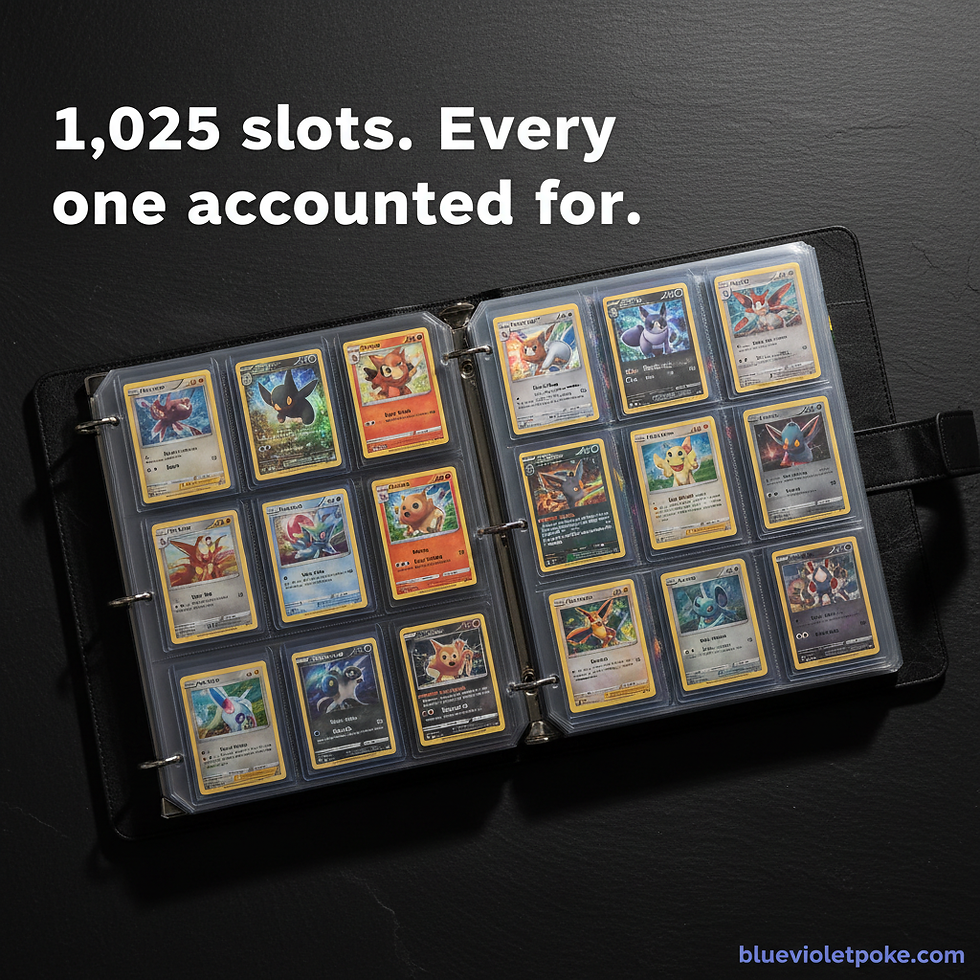
You cannot manage what you don't define. Scope options range from a full 1,025-slot Pokédex ($20,000–$50,000+, 3–10 years) to generation-specific collections, themed collections, or graded-only portfolios.
The key: every scope needs a card type rule, condition minimum, cost target, and success metric. Without these, you're collecting, not operating.
Part 3: Structuring Inputs — The Cost-Per-Slot Framework
Your sourcing strategy should optimize for cost-per-slot, not 'finding cool cards.'
Cost per slot = Total money spent ÷ Slots filled.
Sourcing channel economics:
Bulk lots (COMC, eBay): $2–$8/card — cheap but requires sorting and duplicate management
Retail singles (TCGPlayer): $5–$20/card — consistent quality, slower
Local shops: $8–$25/card — inspect before buying, relationship-building opportunity
Graded singles: $15–$100+/card — only for $50+ value cards
Vintage lots: $10–$50/card — extract Pokédex cards, condition varies
For a 1,025-slot binder at $25/slot, the optimal mix is: 40% bulk lots, 30% retail singles, 15% local shops, 10% graded singles, 5% vintage lots.
Part 4: Measuring Progress — Key Metrics
Completion Percentage
Slots filled ÷ Total slots × 100. Track monthly. Seeing 63% → 70% → 80% is the psychological fuel that keeps long projects alive.
Cost-Per-Slot Over Time
Track monthly. If cost-per-slot is rising, adjust sourcing strategy (more bulk, less retail). A rising cost-per-slot without a completion acceleration is a warning sign.
Liquidity Tiers
Tier 1 (Liquid): sellable in <1 week — target 30–40% of binder
Tier 2 (Semi-liquid): sellable in 1–4 weeks — target 40–50%
Tier 3 (Illiquid): sellable in 1–6 months — target 10–20%
Part 5: Tracking Value — NAV and ROI
NAV = Current market value of all cards − Total cost basis.
Update quarterly. If cost basis is $25,625 and current value is $32,400, NAV is +$6,775 (26.4% gain). NAV tracks your actual return, not just price movements.
Annualized ROI = (Current Value ÷ Cost Basis)^(1/Years) − 1. Target: 15–25% annualized ROI for a well-managed binder project.
Part 6: Grading Strategy for Binder Cards
The grading decision tree: Is the card worth $30+? Is it in PSA 8+ condition? Is there a $20+ spread between raw and graded value? If yes to all three, grade it. If no to any, sell raw.
Risk Factors
Reprints: monitor for new print runs that increase supply
Grading inflation: standards shifts can compress graded values
Market downturns: diversified binder (liquid + illiquid mix) handles downturns better
Condition degradation: invest in proper storage
Takeaway: Treat Your Binder Like a Business
Define scope clearly
Optimize sourcing (bulk lots, retail singles, vintage)
Track cost-per-slot monthly
Measure completion % for psychological wins
Calculate NAV quarterly
Allocate strategically (commons for filling, rares for value)
Grade selectively (only when margin justifies cost)
A binder is not a collection. It's a financial instrument. Manage it like one.
For a tactical guide on sourcing and completing a Pokédex binder, read the companion blog post: 'The Pokédex Binder Project — From Idea to 1,025-Slot Completion.'
Follow BlueVioletPoke LLC for the data-first approach to Pokémon TCG investing. bluevioletpoke.com
Disclaimer: This content is for informational and educational purposes only and does not constitute financial, investment, or legal advice. Pokémon card values are subject to market fluctuations. BlueVioletPoke LLC makes no guarantees regarding investment outcomes. Always conduct your own research before making purchasing decisions.


Comments